
WELCO METOT HENEX TLEVEL - Power Monger


Developer: Bullfrog Productions Sega CD Port: Sprytes Publisher: Electronic Arts Released: 1994
When Electronic Arts first came on the console scene, it was to release two PC ports on Sega’s Genesis - the fighting game Budokan and the early God game by Bullfrog Productions and Peter Molyneaux, Populous.
Populous was groundbreaking for the ability the player had to affect the world itself. By raising and lowering land you could do everything from clear areas for your followers to build settlements to disrupt attacks by enemy humans to lay waste to the entire map via “natural” disasters.
But there wasn’t anything resembling micromanagement of your followers in Populous. You could designate certain titles on particular followers, which dictated their actions somewhat. And you could call for all-out war on the map. But that was about it.
Power Monger goes the other direction. This game is all about issuing specific orders to your followers. Well, really you issue orders to captains of various armies. You start with one, but as your following grows you’ll have multiple military leaders to interact with.
The goal isn’t to wipe the map clean of enemy settlers, but rather to tip the balance of power. To do this you’ll need to take over settlements on each map, either through force or diplomacy. As settlements are controlled and opposing armies are defeated, your forces grow and your options expand.

But along with these new tasks comes a level of micromanagement. You need to feed and supply your forces. And, of course, issue specific orders to specific armies through your various captains. But this is all relative - it’s a lot to manage compared to Populous before it, but most commands sweep across your entire armies, so it’s not like you’re being asked to equip or feed individual soldiers.
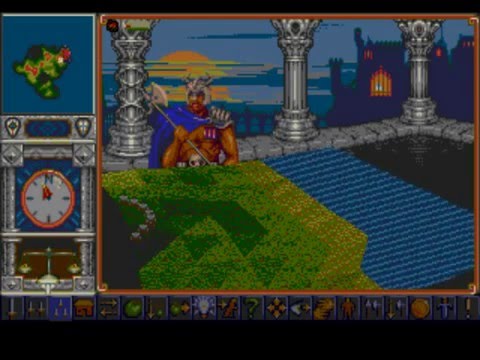
Power Monger borrows the tabletop interface from Populous. At least it did on the PC. When the game came to consoles, this interface was dropped in favor of a more controller-friendly command bar. What’s a bit odd is that the command bar interface is different between the Genesis and Sega CD versions of the game, even though I believe they were both ported by the same developer.
This left more room on the table for the actual play area, which is a good thing because the visuals in Power Monger are so pixelated that it’s pretty hard to tell what you’re looking at most of the time. This is most likely a product of the true 3D graphics being used to render the game world, rather than the tile-based system found in Populous. The upside to this is that the world can be rotated freely. The downside is the aforementioned messy graphics and the much slower framerate and processing time, resulting in the game feeling sluggish.

The port was done by a company called Sprytes, which was actually a sub-company of Vektor Grafix, Ltd, a UK company focused on building 3D systems. Eventually the company focused entirely on 3D simulations and was ultimately bought by Microprose to be its Leeds development studio.
Power Monger came to life mostly as a stopgap title while the rest of the world waited for Populous II. But it also apparently laid the groundwork for a lot of the systems that would be seen in Bullfrog’s Black & White.