WELCO METOT HENEX TLEVEL - Road Rash

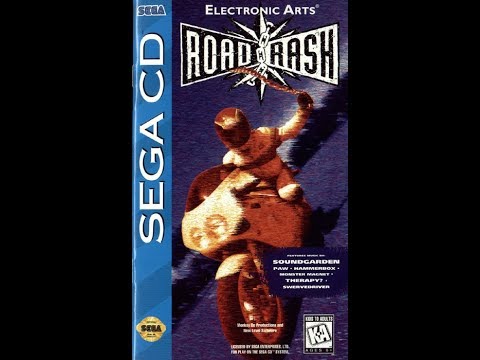
Publisher: Electronic Arts Developer: Monkey Do Productions, New Level Software Released: 1995

In spite of sequels and remakes across at least half a dozen systems, Road Rash has always been a Genesis series to me. It’s such a wonderfully unique take on motorcycle racing. It’s a shining example of early Electronic Arts’ willingness to try something interesting and different in the name of allowing developers and designers stretch their creative muscles.
Road Rash actually started live as Mario Andretti Racing on the Nintendo Entertainment System. But as development wore on the team realized that the venerable old workhorse just didn’t have the power to do what they wanted with their game. Production shifted to the Genesis due to the developers’ ability to better-represent an undulating roadway. And somewhere along the way, the open-wheel race cars were traded in for motorcycles, thanks to being able to see the riders and thus give the game a bit more personality than what would be afforded by staring at the transmission of an Indy car for hours on end.
Even then, Road Rash as we know it was not fully formed. It was originally planned to be a riding simulator, which was apparently not all that impressive when it was shown at a CES early-on in development. In order to liven things up, hand-to-hand combat was added to the mix, inspired by seeing how superbike racers weren’t shy about pushing and jostling one another while racing in close quarters. The combination was a hit, and the rest is history.
After Road Rash II was released Electronic Arts set about developing the next round. EA was ready to support co-founder Trip Hawkins’ upcoming 3DO console, and Road Rash was selected to be a part of that library. Development began on the 3DO version, the Genesis Road Rash 3, as well as the one and only appearance of the game on the Sega CD.
Road Rash on 3DO was a stunning game. This re-imagining of the original title featured extremely 90s full-motion video intros and bumpers, as well as digitized riders (as was all the rage in the post-Mortal Kombat game industry) as well as one of the very first instances of a licensed, redbook audio soundtrack with tunes from Soundgarden, Monster Magnet, Swervedriver, Paw, Therapy and Hammerbox.
Looking back now, this was a complete game changer. And it almost didn’t happen. Apparently Electronic Arts originally approached Soundgarden’s label, which turned down the idea of the band’s music being in a video game. However, the band eventually made the deal happen on its own, thanks in no small part to the fact that the members were actually big fans of the Road Rash games. This deal was the domino that led to many of the other bands signing on. It also didn’t hurt that Soundgarden’s big breakthrough album, Superunknown, hit the charts in 1994, the same year Road Rash was released on the 3DO.

Back on Genesis the decision was made to stick with the digitized riders rather than going with hand-drawn sprites, and I have to say I think it was the wrong way to go. The limited color palette on the Genesis was not kind to the rider sprites, making them look like multicolored blobs sitting astride their crotch rockets rather than badass motorcycle riders.
Road Rash on the Sega CD uses the same engine as that found in Road Rash 3, rather than trying to take advantage of the hardware scaling on the console. And it works. Visually the game is not as impressive as, say, the driving segments in Batman Returns, but more importantly, it feels like a Road Rash game.
The Sega CD game is essentially a port of the 3DO title, featuring the same tracks and the same stylized characters, and the same full-motion video segments. This is a mixed blessing. On the one hand, the character-based campaign mode is a great addition to the series, where you start with different amounts of money and different bikes based on who you decide to play as. On the other side, the relatively high-res, high-color character portraits just don’t make a good transition to the Sega CD. By 1995 we’d come to accept that video was never going to look great on the system, but every single menu screen in Road Rash just looks awful.
One huge advantage enjoyed by the Sega CD version was the soundtrack, which is used to much greater effect than on the 3DO. See, the 3DO version streamed each track directly from the disc during gameplay. And while that meant the graphics looked fantastic, the system wasn’t able to stream the amazing soundtrack at the same time, and so you only heard those great songs in between races.

On the other hand, Road Rash on the Sega CD loaded the track into memory before each race, meaning you got to rock out to stuff like Rusty Cage and Kickstand while you were screaming down the highway taking swings at your adversaries and running over pedestrians. Good times! The music was meant to be coming from your bike’s stereo, so if you wipe out and your ride slides too far away from you, the volume actually decreases until you get back to it and jump back on.
The gameplay, though, is classic Road Rash and it’s all great. The undulating courses filled with vehicle traffic, crossroads, obstacles and pedestrians all with the potential to knock you off your seat and send you sailing into a painful-looking roll, just to get back up and frantically run to your bike, hoping a cop doesn’t stop nearby to arrest you. Attempting to make a pass into oncoming traffic as you crest a hill, not knowing what lies on the other side is absolutely breathtaking.
Road Rash hit the Sega CD in 1995, a year after the 3DO game. And it’s a shame that those two titles basically indicate the peak of this great series. There were a few more Road Rash games released in the ensuing years, but nothing really reached the level of quality found in the games released in 1994 and 1995.