WELCO METOT HENEX TLEVEL - Robo Aleste

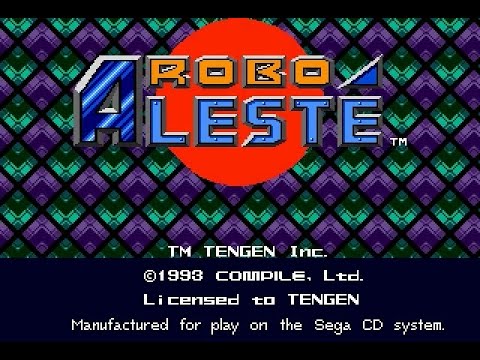

Developer: Compile Publisher: Compile (JP), Tengen (US), Sega (EU) Released: 1992/1993
When the Aleste series began life on the Sega Master System in 1988, it resembled so many other shooters at the time. Sometime in the distant future a supercomputer has gone berserk, and it’s up to a lone pilot or pilots to fly their technologically advanced fighters to the heart of the problem in order to blow it sky high.
On the MSX port, the story remained largely similar, though it did take place in the present day rather than “Space Year 9180.” Aleste 2, released in 1989, was a direct sequel to the original game, and thus featured a very similar setting.
By the time Compile decided to port Aleste 2 to the Mega Drive, the team wanted to switch things up a bit. The decision was made to put pilots in charge of giant, mechanized soldiers, and the entire game given a visual overhaul that mixed futuristic tech with ancient Japanese architecture and imagery, and the title changed to Musha Aleste. The game still takes place in the 91st century (or 2290 if you go with the US version), but the look is nothing like the traditional space shooter.
For this spiritual follow-up to MUSHA on the Sega CD, Compile just decided to go all in on the ancient Japanese imagery by setting the game in 16th century, making Sengoku era warlords main characters in the game. In this alternate history, a mysterious ship was grounded on shore of the island Taegashima. Within was discovered a 25-foot humanoid robot powered by a steam engine. Controlled by human pilots, these robots were soon replicated and improved upon by the various clans, thus changing the art of war in Japan.

You are Kage, a member of Nobunaga Oda’s elite ninja force, White Fang. You command the ship Aleste. Oda’s enemies are allying against him and closing in. You are the last hope for the clan. You set off on a mission to destroy the Imagawa and Mouri forces. Grounding the story in this alternate history gives the whole game a really unique look and feel. Plus, since this is a Sega CD game we’re treated to lengthy, animated, fully voiced cutscenes throughout the game to forward the story.
MUSHA is a highly sought after game, and deservedly praised, but I actually prefer Robo Aleste. Visuals and story aside, I like the weapon system more. Rather than a supply of smaller ships that can be reconfigured and replaced at will, aleste has two satellite ships which can be thrown forward when needed, but which also act as the source of any special weapons. And, just like in previous games, the kunai-like standard projectiles can be updated by locating and harvesting P-capsules.
Special weapons are color coded and can be upgraded up to level three. Swapping out one weapon for another will maintain the current special weapon level. But if there’s one flaw in this game, I’d have to say the weapon balance is it. Apparently, when the game was brought to US for Tengen a couple of these special weapons were adjusted, and the yellow, homing attack was buffed to the point that it is overpowered. It doesn’t ruin the game, but it’s awfully hard to maintain your self control if you get into a tight spot.

While I’ve grown to love this game for the gameplay, my very first impression of it was that it has a fantastic soundtrack. One of the best on the system, in my opinion. It’s mostly a techno flavour (as was popular at the time) mixed with more traditional Japanese sound. And it just absolutely rocks. Thankfully, it’s redbook audio, so this disc spent a fair amount of time in the portable CD player I had velcroed to the dashboard of my car back in the mid-nineties.
When people ask me what games they should play on the Sega CD, Robo Aleste always makes my short list. With an Aleste collection recently announced for modern systems, I sure hope there’s a second one planned, and that it will include this underappreciated classic.